A typical home electric sauna heater costs between $10 and $25 a month to run for a household using it four times a week at 45 minutes a session, depending on heater size, local electricity rates, and cabin insulation. Wood-fired heaters trade a lower per-session energy cost for the price and labor of firewood. Comparing the two side by side, and comparing different electric heater sizes against each other, is the only way to know what your own setup will actually cost before you install it.
How Much Electricity Does a Sauna Heater Actually Use?
Most home electric heaters range from 4.5kW to 9kW, matched to cabin volume rather than floor space. A 6kW heater running at full draw for 45 minutes uses roughly 4.5 kWh per session, though thermostats cycle the element on and off once temperature is reached, so real draw over a session is usually closer to 60 to 70 percent of that number. At a national average residential rate near 16 cents per kWh, one session lands around 45 to 65 cents. Four sessions a week puts you at $8 to $12 a month for a mid-sized heater, climbing toward $18 to $25 for a larger 9kW unit run just as often. Rates vary a lot by state, so a household in a higher-cost region should expect the top of that range or slightly above it.
How Does That Compare to a Wood-Fired Heater?
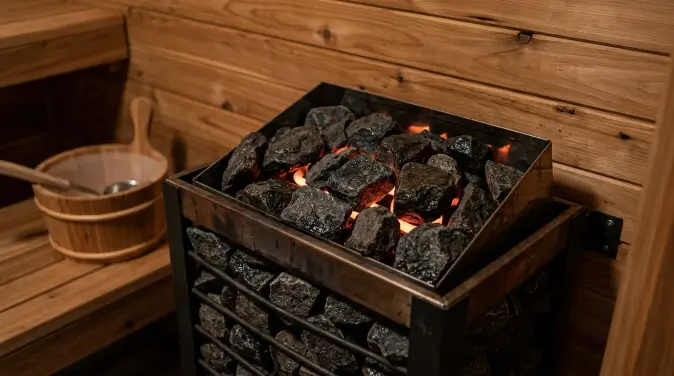
A wood-fired heater sidesteps the electric bill almost entirely, but the comparison isn’t as simple as “free heat.” A single session burns roughly 10 to 20 pounds of dry hardwood depending on cabin size and outdoor temperature. If you’re buying seasoned firewood at $250 to $350 a cord, that works out to somewhere around $1 to $3 per session in wood cost, more expensive per session than most electric setups once you account for the full cord price. If you’re cutting and splitting your own wood, the direct cost drops close to zero, but the time investment is real and the heater needs 45 minutes to an hour to reach temperature versus 20 to 30 minutes for a sized electric unit. Wood heaters also have no thermostat, so you’re managing the fire manually rather than setting a temperature and walking away.
Does Heater Size Change the Math?
Bigger isn’t automatically more expensive to run. An undersized heater working to hold 180°F in a cabin it can’t quite handle will cycle at high output almost continuously, while a correctly sized or even slightly oversized heater reaches target temperature faster and then cycles down, spending more of the session at low draw. The practical lesson is to size the heater to the room’s actual cubic footage, not to whatever unit happens to be cheapest upfront, since an undersized heater ends up costing more in both electricity and patience over time.
How Much Does Insulation and Cabin Quality Matter?
This is where monthly cost swings the most. A cabin with a proper foil vapor barrier behind the wall paneling, tight door seals, and solid cedar or hemlock construction holds heat efficiently, meaning the heater reaches temperature and then coasts. A poorly built or older cabin with gaps around the door or thin uninsulated walls can take twice as long to reach the same temperature, which roughly doubles the electric cost per session regardless of heater size. If you’re budgeting for a new build or comparing a used cabin, insulation quality matters as much as the heater spec plate.
What About Infrared Versus Traditional Electric?
Infrared sauna heaters use carbon or ceramic panels rather than a heated rock bed, typically draw less total wattage, often in the 1,500 to 1,700 watt range, and commonly plug into a standard 120V outlet rather than requiring a dedicated 240V circuit. That lower draw generally means a lower per-session cost, often $5 to $10 a month for regular use, but infrared cabins run at lower air temperatures, usually 120 to 150°F, since they heat the body directly rather than the surrounding air. Traditional electric heaters reach higher peak temperatures and produce the classic steam-on-stones experience that infrared can’t replicate, so the cost comparison isn’t purely about dollars; it depends on which type of heat you actually want.
What Else Adds to the Monthly Total?
Beyond electricity or wood, factor in stone replacement every one to two years for electric heaters (a bag of sauna rocks typically runs under $50), occasional door seal replacement, and higher electric bills in winter when the ambient temperature the heater has to overcome is lower. None of these are large costs individually, but they add up over a year. Before committing to a specific kW rating, it’s worth checking current pricing across a few models since sizing and wattage vary more between brands than people expect. Sweat Decks lists heaters across the common kW ranges if you want a starting point for comparison shopping.
See also: Scoring the Cheapest Way to Buy MK-677: A Rubric, Not a Vibe
Can You Lower the Monthly Cost Without Buying a New Heater?
A few habits make a real difference without touching the equipment. Preheating only as long as needed rather than leaving the heater running well past the point stones reach temperature wastes energy for no benefit. Closing the cabin door promptly between sessions keeps heat from bleeding out and forces the element to work harder to recover. Checking the door seal once or twice a year and replacing a worn gasket, often under $30 in parts, can meaningfully cut warm-up time on an older cabin. Running sessions back to back as a household, rather than each person reheating from a cold start hours apart, also trims total energy use since the cabin stays warm between uses. None of these require new equipment, just a bit of attention to how the heater is actually being used day to day.
Frequently Asked Questions
What is the average monthly electric cost to run a sauna heater? For four sessions a week at 45 minutes each, most households land between $10 and $22 a month, depending on heater size and local electricity rates.
Is a wood-fired heater cheaper to run than electric? Per session, firewood can be cheaper if you have a free or low-cost wood source, but the labor of feeding the fire and the lack of thermostat control make electric more predictable for regular users.
Does a bigger heater always cost more to run? Not necessarily. A properly sized heater reaches temperature faster and cycles less often than an undersized one straining to keep up, so oversizing slightly can sometimes lower total run time.
How much does insulation affect running cost? Significantly. A poorly insulated cabin can double heating time and cost compared to one with proper foil vapor barrier and cedar or hemlock paneling, since heat escapes through gaps almost as fast as the heater produces it.
Are infrared heaters cheaper to run than traditional electric heaters? Infrared panels typically draw less wattage and run on standard 120V outlets, so they often cost less per session, though traditional heaters reach higher peak temperatures that some users prefer.
References
- Hussain, J. N., et al. “Cardiovascular and Other Health Benefits of Sauna Bathing: A Review of the Evidence.” Mayo Clinic Proceedings, 2018. https://pubmed.ncbi.nlm.nih.gov/30077204/
- “Benefits and Risks of Sauna Bathing.” The American Journal of Medicine, 2001. https://pubmed.ncbi.nlm.nih.gov/11165553/
- Hussain, J. N., et al. “Does the Combination of Finnish Sauna Bathing and Other Lifestyle Factors Confer Additional Health Benefits? A Review of the Evidence.” Mayo Clinic Proceedings, 2023. https://pubmed.ncbi.nlm.nih.gov/37270272/
- Harvard Health Publishing. “Saunas and Your Health.” https://www.health.harvard.edu/staying-healthy/saunas-and-your-health
By Melissa Cordero