A three-bay shop in Arnold called me out last spring to look at four dark patches under its bay doors, each one roughly the shape of a car. The owner had money set aside for a sealcoat on a fifteen-year-old lot, not for a repair, and he wanted to know why that one strip had gone soft while the parking rows out front were still sound. Chemistry explains it, and it is why the paving companies Arnold MO shop owners hire should walk a lot with a screwdriver before quoting a price. Motor oil and transmission fluid do not simply stain asphalt. They dissolve the binder that glues the aggregate together, so a coating sprayed over softened pavement seals the problem in rather than stopping it.
Asphalt binder is itself a petroleum product, which is the part most lot owners never hear. Put a petroleum solvent on it and the two mix readily. Work published in Construction and Building Materials in April 2026 reported that diesel and asphalt binder dissolve into one another easily because their chemical compositions are so similar, and that fuel-exposed pavement ravels, potholes and peels years ahead of schedule.
Oil Dissolves The Binder Holding Everything
Softening shows up long before a hole does. Press a screwdriver into a fresh drip zone on a 90-degree afternoon and it sinks; do the same six feet away and it barely marks the surface. On most jobs the softened area is wider than the visible stain, because the fluid spreads sideways through the mix while it works its way down. A tire parked on that spot at two in the afternoon in July will print into it, and that print does not fully come back out once the pavement cools.
Oil eats what oil built.
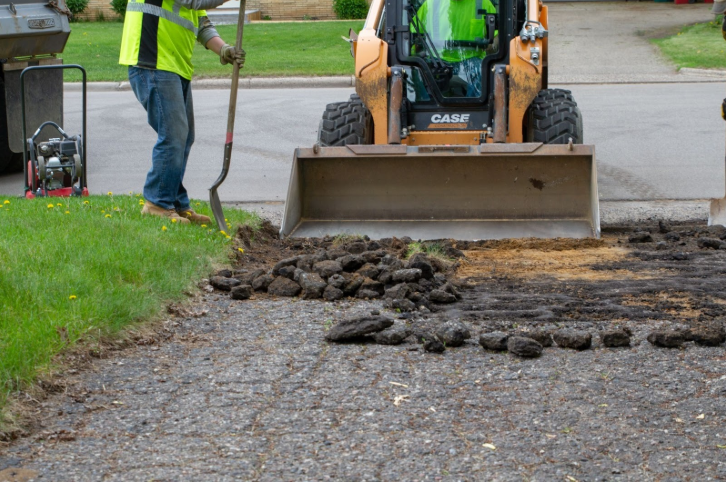
Fixing it is not exotic work. A crew saws out the softened area, digs down two or three inches, hauls off the contaminated material, and patches with fresh hot mix so the sealer has something firm to bond to. On a shop lot with four affected squares of roughly four feet each, budget around $600 for that repair work. Honestly, closer to $900 once you account for a crew mobilizing to a job that small and the cones needed to keep one bay reachable while the patches cure. That still leaves most of a $2,500 annual maintenance ceiling for the sealcoat itself, which is the order the money should go in. Most paving companies Arnold MO owners call will quote the sealcoat first, because it is the simpler sale, so the burden of raising the soft spots tends to fall on the owner.
See also: What the Norwood Scale Actually Tells You (And What It Doesn’t)
Questions Shop Owners Ask Before Sealing
Three questions come up in the lot almost every time, usually inside the first ten minutes. They are worth answering flatly, because the wrong answer costs a season of pavement life. None of them need a technical background to follow.
Can I just sealcoat over the soft spots?
No, and the coating will give you away within a month. Sealer needs a firm surface to cure against, and over soft asphalt it stays pliable until a tire scrubs it off, leaving a patch line visible from the street. What we find is that owners who coat straight over drip zones are standing on the same four squares the next summer, except by then the squares are shallow depressions.
How do I know it is oil damage and not just a stain?
A stain sits on the surface, while a softened area gives under pressure, so the test is physical rather than visual. Push a key or a screwdriver in on a hot day, then compare that resistance to clean pavement a few feet over. If the area also looks slightly sunken or carries fine interconnected cracking, the binder underneath has already turned loose of the stone.
Is a fifteen-year-old lot even worth sealing?
Usually, provided the base is still solid and the cracking has not reached the alligator pattern that signals structural failure. The line good contractors draw is simple enough to hold in your head: worn but sound gets coated, structurally damaged gets repaired first. A lot that has faded to dull gray and sheds loose sand underfoot is asking for sealer, and that is a maintenance bill rather than a replacement bill.
The If Then Rule For Soft Spots
One rule of thumb is worth carrying into the conversation with any contractor. If a screwdriver sinks into the dark area while clean pavement resists it, that area gets cut out and patched before sealer touches the lot. If it resists everywhere and the discoloration is only cosmetic, a degreasing wash plus an oil-spot primer under the sealcoat is normally enough. The dividing line is physical resistance, not how bad the staining looks from the office window, and that is the reason an on-site inspection beats a phone quote.
Order of operations matters more here than product selection. Deal with the softened pavement first, coat second, and keep absorbent near the bay doors so the next leak gets caught before it reaches the binder. A contractor who walks the lot and prices the two jobs separately is protecting a fifteen-year-old surface that has years left in it, while one who quotes a flat per-square-foot sealcoat over the phone has not seen the patches at all. That difference is worth the twenty minutes it takes to meet somebody out there.