The stain shows up in the same corner of the back bedroom ceiling every April, a brown ring in the plaster about the size of a dinner plate. Directly above it sits a 640 square foot flat addition, tacked onto a 1962 ranch, whose seam has been sealed with roof cement four springs running. Each patch holds through the summer. By the next thaw it has split again. The argument here is plain arithmetic: paying once for a rubber membrane over that addition costs less per year of dry ceiling than patching the seam forever. It also explains why bids from the roofing companies Southbury CT homeowners call first can land four times apart, because some of them are pricing a season and some are pricing a few decades.
Tar Patches Buy A Season, Not A Decade
Roof cement is a patching material for holes. It was never meant to hold a joint that moves, and the joint where a flat addition meets a pitched wall moves all year. Membrane, sheathing and framing all swell in July and shrink again in January, each at its own rate, and the seam between them opens and closes with them. Cement cures hard, so it cannot follow that motion, and by the second freeze there is a hairline crack running the length of the repair. Job after job on additions like this one, the same eighteen inches lets go first, right where the low slope deck ties into the main house wall.
The alternative has a long track record. In March 2026 the trade press was still pointing at the same body of evidence: an EPDM Roofing Association survey paired with peer reviewed testing put properly installed membranes at 38 or more years of service life, with 16 percent of the professionals surveyed reporting 45 year old EPDM still performing on the buildings they inspected. A tube of cement is not in that category. One rule before anyone climbs up for a closer look, and it holds without exception: stay off a low slope roof when the surface is wet, frosted, or scattered with loose gravel. There is nothing up there to grab and nothing to stop a slide.
Built Up Roofs Then, Single Ply Membranes Now
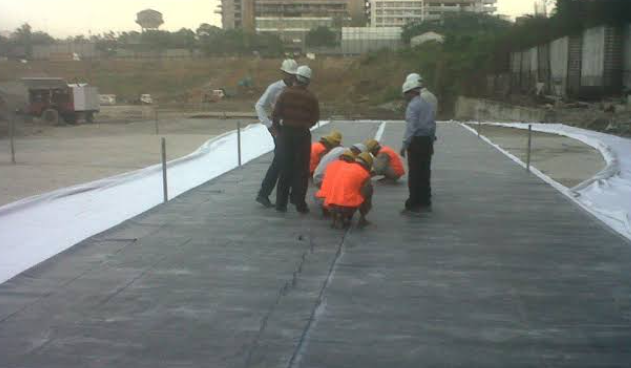
Ten or fifteen years ago an addition this size usually got a built up roof, which meant layers of felt mopped down in hot asphalt and a gravel surface holding the whole assembly in place. It worked. Plenty of those roofs are still doing their job on ranches around the state. It also meant a kettle running in the driveway, a crew of three, a smell the neighbors noticed by mid morning, and a finished roof with dozens of overlapping edges in it. Every one of those edges was somewhere water could eventually find. Today the same deck gets a single sheet of rubber instead: EPDM rolls in widths that cover 640 square feet with one seam or two, bonded rather than mopped, and a small crew is usually off the property by late afternoon.
The Real Cost Per Year Of Coverage
Compare the two options the way you would compare tires, by cost per year rather than cost per visit. Patching wins every single spring and loses the decade. The figures below are illustrative rather than a quote, but the shape of them holds on small residential flat roofs.
Say the yearly patch runs $450 in labor and material, which over four springs comes to $1,800. Add one interior repair, because the plaster finally needed skim coating and paint after the third leak, at a hypothetical $900. That is $2,700 across four years, roughly $675 a year, and the seam sits exactly where it started. Now price the membrane: 640 square feet at an illustrative $11 per square foot is $7,040, plus about $600 for new edge metal and a proper termination at the house wall, so call it $7,640 out the door. Spread over a conservative 25 year service life, that comes to about $306 a year. Under half the annual cost of the patching cycle, with a dry ceiling the whole way through.
Those two numbers, $675 and $306, are the entire case.
See also: Dripped Oil Softens Asphalt Faster Than Sunlight Ever Will
Seams And Flashing Decide Membrane Lifespan
None of that long service life arrives automatically. A membrane fails at its edges and almost never out in the middle of the field, so the money that matters is spent wherever the rubber stops lying flat. The termination at the main house wall should run up behind the siding or into a cut reglet instead of stopping short and getting caulked. Inside corners want a molded boot rather than a folded flap of scrap. Seams need clean, primed surfaces and real pressure from a roller, which sounds fussy because it is (this is the part of the job worth watching from the driveway with a cup of coffee).
So ask whoever is quoting the work how they intend to handle the transition where the flat deck meets the pitched roof above it. The answer is more revealing than the price. A crew that talks about stepping flashing up under the shingles and lapping the membrane behind it has clearly built this detail before, while a crew that plans to run cement across the joint is quoting you the same four springs you already paid for.
Replace The Detail That Keeps Splitting
The real decision on a 1962 ranch with a 640 square foot rear addition is not roof versus no roof. It is whether the next $450 buys another season or finishes the problem. A seam that has opened three springs in a row is telling you what the fourth patch is worth. The roofing companies Southbury CT owners end up calling will quote a wide range for a deck that size, and the useful question is not which number is smallest but which proposal spells out the wall termination and the seam work in writing. Get those details on paper, divide the price by the years of coverage, and the arithmetic settles it for you.